A current transformer (CT) is a type of transformer that is used to reduce or multiply an alternating current(AC). It produces a current in its secondary which is proportional to the current in its primary.

Current transformers, along with voltage or potential transformers, are instrument transformers. Instrument transformers scale the large values of voltage or current to small, standardized values that are easy to handle for measuring instruments and protective relays. The instrument transformers isolate measurement or protection circuits from the high voltage of the primary system. A current transformer provides a secondary current that is accurately proportional to the current flowing in its primary. The current transformer presents a negligible load to the primary circuit.
Current transformers are the current-sensing units of the power system and are used at generating stations, electrical substations, and in industrial and commercial electric power distribution.
Functions
Current transformers perform the following functions:
- Current transformers supply the protective relays with currents of magnitude proportional to those of power circuit but sufficiently reduced in magnitude.
- The measuring devices cannot be directly connected to the high magnitude supplies. Hence current transformers are used to supply those devices with currents of magnitude proportional to those of power.
- A current transformer also isolates the measuring instruments from high voltage circuits.
Principle
The basic principle of the current transformer is the same as that of the power transformer. Like the power transformer, the current transformer also contains a primary and a secondary winding. Whenever an alternating current flows through the primary winding, alternating magnetic flux is produced, which then induces alternating current in the secondary winding. In the case of current transformers, the load impedance or “burden” is very small. Therefore the current transformer operates under short circuit conditions. Also the current in the secondary winding does not depend on load impedance but instead depends on the current flowing in the primary winding.
The current transformer basically consists of an iron core upon which primary and secondary windings are wound. The primary winding of the transformer is connected in series with the load and carries the actual current flowing to the load, while the secondary winding is connected to a measuring device or a relay. The number of secondary turns is proportional to the current flowing through the primary; i.e., the larger the magnitude of current flowing through the primary, more the number of secondary turns.
The ratio of primary current to the secondary current is known as the current transformation ratio of the CT. Usually the current transformation ratio of the CT is high. Normally the secondary ratings are of the order 5 A, 1 A, 0.1 A, whereas the primary ratings vary from 10 A to 3000 A or more.
The CT handles much less power. Rated burden can be defined as the product of current and voltage at the secondary side of the CT. It is measured in volt ampere (VA).
The secondary of a current transformer should not be disconnected from its rated burden while current is flowing in the primary. As the primary current is independent of the secondary current, the entire primary current acts as a magnetizing current when secondary is opened. This results in deep saturation of the core, which cannot return to normal state and so the CT is no longer usable.
Types: Bar, Wound, and Window


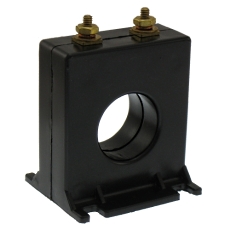
Types
Based on the function performed by the current transformer, it can be classified is follows:
- Measuring current transformers. These current transformers are used along with the measuring devices for the measurement of current, energy, and power.
- Protective current transformers. These current transformers are used along with the protection equipments such as trip coils, relays, etc.
Based on the function construction, it can also be classified as follows:
- Bar Type. This type consists of a bar of suitable size and material forming an integral part of the transformer.
- Wound Type. This type has a primary winding of ore than one full turn wound over the core.
- Window Type. This type has no primary winding. The secondary wind of the CT is placed around the current flowing conductor. The magnetic electric field created by current flowing through the conductor induces current in the secondary winding, which is used for measurement.
Errors
The ideal current transformer may be defined as one in which any primary condition is reproduced in the secondary circuit in the exact ratio and phase relationship.
For an ideal transformer:
Ip Tp = Is Ts
Ip / Is = Ts / Tp
Therefore the ratio of primary and secondary winding currents equal to the turns ratio. Also the primary and secondary winding currents are exactly 1800 in phase.
In an actual transformer, the windings have resistance and reactance and also the transformer has magnetizing and loss component of current to maintain the flux. Therefore, in an actual transformer the ratio of current is not equal to the turns ratio and also there is a phase difference between the primary current and the secondary currents reflected back on the primary side and consequently we have ratio error and phase angle error.
Kn = turns ratio
= number of secondary winding turns / number of primary winding turns,
rs, xs = resistance and reactance respectively of the secondary winding,
rp, xp = resistance and reactance respectively of the primary winding,
Ep, Es = primary and secondary induced voltages respectively,
Tp, Ts = number of primary winding and secondary winding turns respectively,
Ip, Is = primary and secondary winding currents respectively,
θ = phase angle of the transformer
Φm = working flux of the transformer
δ = angle between secondary induced voltage and secondary current,
Io = exciting current,
Im = magnetizing component of exciting current
Il = loss component of exciting current,
α = angle between Io and Φm
Actual transformation ratio
R = Ip / Is
= Kn + (Il cos δ + Im sin δ)/ KnIs
Phase angle θ = 180/ π (Il cos δ + Im sin δ)/ KnIs
Ratio error = (KnIs - Ip)/ Ip x 100%
= (Kn – R) / R x 100 %
